
A year after its first morning brief, Rietspruit Digital, our fictional Gqeberha product studio, had three always-on agents. The founder's AI chief of staff prepared briefs, drafts and proposals. The repository agent turned issue comments into pull requests. A small finance agent watched invoices and renewals. Each had been set up by a different person, with its own idea of what "draft only" meant, its own memory and its own logs. When a client asked why it had received a reminder for an invoice it had already paid, nobody could say which agent had sent it, on what trigger, or with what evidence.
The individual agents were reasonable. What Rietspruit lacked was one architecture they all fitted into.
An always-on agent is a long-lived operating capability, not a smarter chatbot. It needs one main flow from trigger to audited action, and four rails, permissions, guardrails, observability and memory, that apply across every step and each have a named owner.
The reference architecture
Download the diagram as an SVG file for your own architecture documents. It is product-neutral: map each box to the tools you actually use.
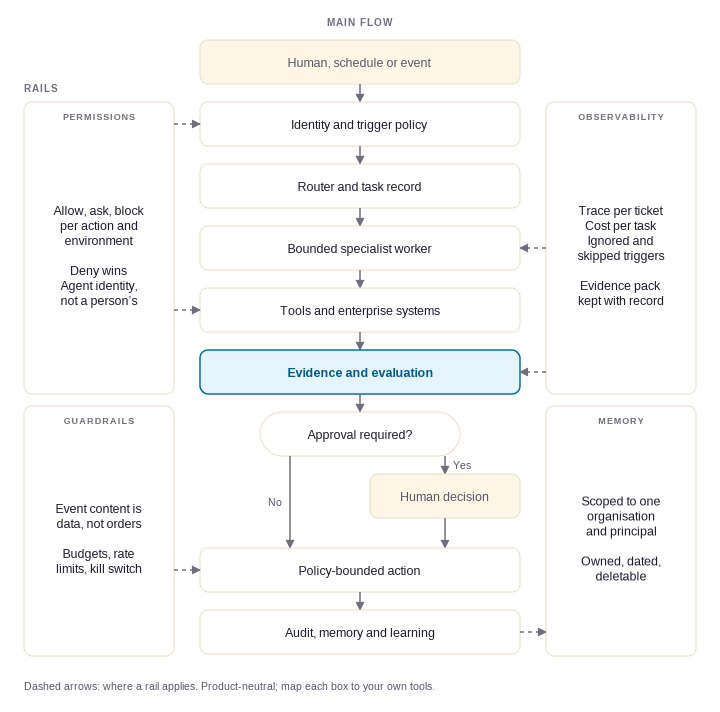
The main flow runs top to bottom. Work starts with a person, a schedule or an event. Identity and trigger policy decide whether the work may start and on whose authority. The router decides what to do with it and writes a task record. A bounded specialist worker does the work through tools and enterprise systems. The result is checked against evidence and evaluation. If the action needs approval, a person decides. The policy-bounded action follows, and everything is written to audit, memory and learning.
The four rails are not steps. They apply to the whole flow, which is why they are drawn beside it rather than inside it.
The main flow, step by step
| Step | Purpose | Key control | Evidence it leaves | Series part |
|---|---|---|---|---|
| Human, schedule or event | Start the work | Initiator recorded, never inferred | Trigger record | Part 2 |
| Identity and trigger policy | Decide whether this initiator may start this work | Admission rules; signature checks; deduplication by event ID | Rule matched, or refusal | Part 2, part 5 |
| Router and task record | Accept, attach or ignore; create a bounded task | Recorded reason for every decision; mandate, scope, budget | Task record with mandate | Part 5 |
| Bounded specialist worker | Do one task well | Own session and workspace; only the tools the mandate needs | Trace of steps | Part 3 |
| Tools and enterprise systems | Read and change real records | Agent's own least-privilege identity; allow, ask, block per action | Tool calls and results | Part 5 |
| Evidence and evaluation | Show the work is right, not only finished | Completion claims must cite recorded evidence; checks in code where possible | Evidence pack | Part 6 |
| Approval required? | Route ask-class actions to a person | Decided by action class, not by the agent | Decision point recorded | Part 5 |
| Human decision | Approve, change or refuse with the evidence in view | Named approver; time to look | Approval record | Part 1 |
| Policy-bounded action | Make the change in the world | Idempotency key; block rules enforced where the action executes | Action result | Part 5 |
| Audit, memory and learning | Keep the record; update memory; improve | Write policy for memory; failures become evaluation cases | Audit entry; memory items with sources | Part 4, part 6 |
The order carries most of the design. Identity comes before routing, so a stranger's comment never reaches a worker by accident. Evidence comes before approval, so the approver decides on what was done. Approval comes before the action, so nothing in the ask class happens first and gets explained later.
The four rails
| Rail | What it governs | Typical owner | Minimum to start |
|---|---|---|---|
| Permissions | What the agent may do, per action and environment; under which identity | Security, with the business owner of each action class | Allow, ask and block matrix; block wins; the agent's own credentials |
| Guardrails | What the agent must never be talked into, and how much it may spend | Platform team | Event content treated as data; budgets and rate limits; a tested kill switch |
| Observability | What happened, at what cost, and what did not happen | Platform or operations team | Trace per task; cost per task; skipped runs and ignored triggers visible |
| Memory | What the agent knows between runs, and for how long | Data owner for each memory layer | One space per organisation and principal; owned, dated, deletable items |
Every rail needs an owner who is not the agent. The question to ask in any design review is simple: if this rail fails at 02:00, who finds out, and how?
Three deployment sizes
The same architecture works at different sizes. What changes is how much of it a product gives you and how much you build.
| Size | Example | What to build first | What can wait |
|---|---|---|---|
| Founder | One AI chief of staff on a hosted or desktop tool | Delegation register; read and draft only; separate mailbox view; run history check | Event triggers; shared memory |
| Team | Rietspruit's three agents | One trigger record format; shared permission matrix; agent identities; one place for evidence and run history | A full platform |
| Enterprise | Many agents across business units | Central policy for the rails; release bundles; evaluation gates; integration with identity, logging and records | Nothing on this list |
For the enterprise size, the reference architecture sits inside the boundaries described in The Enterprise AI Control Plane, starting with who owns which control in an enterprise AI request, and inside the landing zone described in agentic landing zones: from governed intelligence to governed action. The secure enterprise AI reference architecture covers the security layers beneath it.
Fill in the design canvas
The series' downloadable tool, the always-on agent design canvas (Markdown version), turns the architecture into one page per agent. It has five sections: trigger policy, permissions (allow, ask, block), memory scope, evidence required, and approval gates, plus an owner and a review date.
Use it this way:
- Fill in one canvas per agent, not per product. Rietspruit needed three.
- Fill it in before connecting anything, then again after two weeks in observe or draft-only mode.
- Review the canvases together. Inconsistent rules across agents are the usual source of incidents like Rietspruit's duplicate reminder.
- Keep the canvas with the agent's configuration, and change both together.
What this architecture does not claim
The architecture describes the controls an always-on agent needs. It does not claim that current agents can run without them, or that any product provides all of them. Several of the products in this series are early. The DeepSeek dsh-superagent repository describes itself as a research prototype, not an official product, and in the public video demonstration this series draws on, the presenter had to tag the prototype three times before it picked up an issue. Treat autonomy as something each action class earns with evidence, one class at a time, not a setting.
What this means for South Africa
South African organisations will mostly build always-on agents on models and platforms from elsewhere. The architecture is where local value and local accountability sit: the admission rules, the permission matrix, the memory boundaries, the evidence and the people who approve. Those are built and owned here, and they are what a customer, an auditor or the Information Regulator will ask about. Small firms can start with the founder-sized version this month. Larger organisations should treat the rails as shared platform services, so each new agent inherits them rather than reinventing them.
This is the final part of the series. Previous: Part 6, Why an agent must produce evidence, not just output. All seven parts are on the series page.
Sources and limits: this series draws on two public video discussions, one on using an AI chief of staff and one comparing personal and event-driven agents. Their points are paraphrased, not quoted, and were checked on 23 November 2026 against timestamped transcripts and the published videos' descriptions and chapter markers. Product behaviour comes from official documentation checked on 23 November 2026 and may change. Rietspruit Digital is fictional. The reference architecture is CloudNala's own analysis.
How CloudNala can help
CloudNala designs always-on agent architecture from trigger to audit. We map your current and planned agents onto the reference architecture, fill in a design canvas for each with your owners, design the four rails as shared services, and run the first agent in observe mode until its evidence supports each step up in authority.
Work with CloudNala
CloudNala helps organisations move from technology ambition to practical execution across cloud, AI, data, platform engineering and digital services.
Whether you are exploring AI, modernising your cloud environment, building a public-sector digital service, or turning an idea into a working MVP, we can help you shape the roadmap and deliver the next step.
Book an Always-On Agent Architecture Review or write to us at consult@cloudnala.co.za