
At 19:40 on a Friday, a customer of Blouberg Bank, our fictional South African bank, noticed three card payments she had not made. She opened the app and tapped "report fraud". The assistant asked her to verify her identity. The one-time PIN never arrived. She phoned the contact centre and waited 25 minutes. When she got through, the agent could see her accounts but could not open a fraud case, because the case system's sign-in was failing for staff too. Her card was eventually blocked by a supervisor using a separate fraud console, 70 minutes after she first tried.
At no point that evening did Blouberg's cloud provider, model provider or network monitoring show red. Each component was up. The journey was broken because the SMS gateway was throttling, and the staff sign-in depended on the same identity service as the customer's verification. A green dashboard measures components. A customer experiences a chain.
Part 7 of The Enterprise AI Control Plane covers what happens when a model or a cloud fails. This part widens the frame to the whole service journey: channels, identity, the case, workflow, systems of record, partners, staff and the messages the customer receives. The case, as defined in Part 2, is the anchor that holds it together.
A green dashboard does not mean the journey works
Component availability multiplies. Take an illustrative journey that depends on eight components in sequence: app, identity, SMS gateway, case system, workflow, card system, courier integration and notifications. If each is available 99.9% of the time, and failures are independent, the chance that all eight are up at once is 0.999⁸, about 0.992. That is 99.2% for the journey.
Over a year of 8,760 hours, 0.1% unavailability for one component is about 8.8 hours. For the journey, 0.8% is about 70 hours (8,760 × 0.0080 ≈ 70). Each team can meet its 99.9% target while customers experience eight times as much disruption as any one team reports. Real failures are not independent, which can make the picture better or worse: Blouberg's staff and customer sign-in shared one identity service, so a single fault broke two links at once.
The fix is to measure the journey as the customer experiences it. Google's SRE book calls this black-box monitoring: "testing externally visible behavior as a user would see it". For a service journey, that means a synthetic test customer reporting a test fraud on a test card, every few minutes, through each channel, and an alert when the journey fails even if every component is green. CloudNala's instrument the customer journey, not only the infrastructure covers the measures that sit on top.
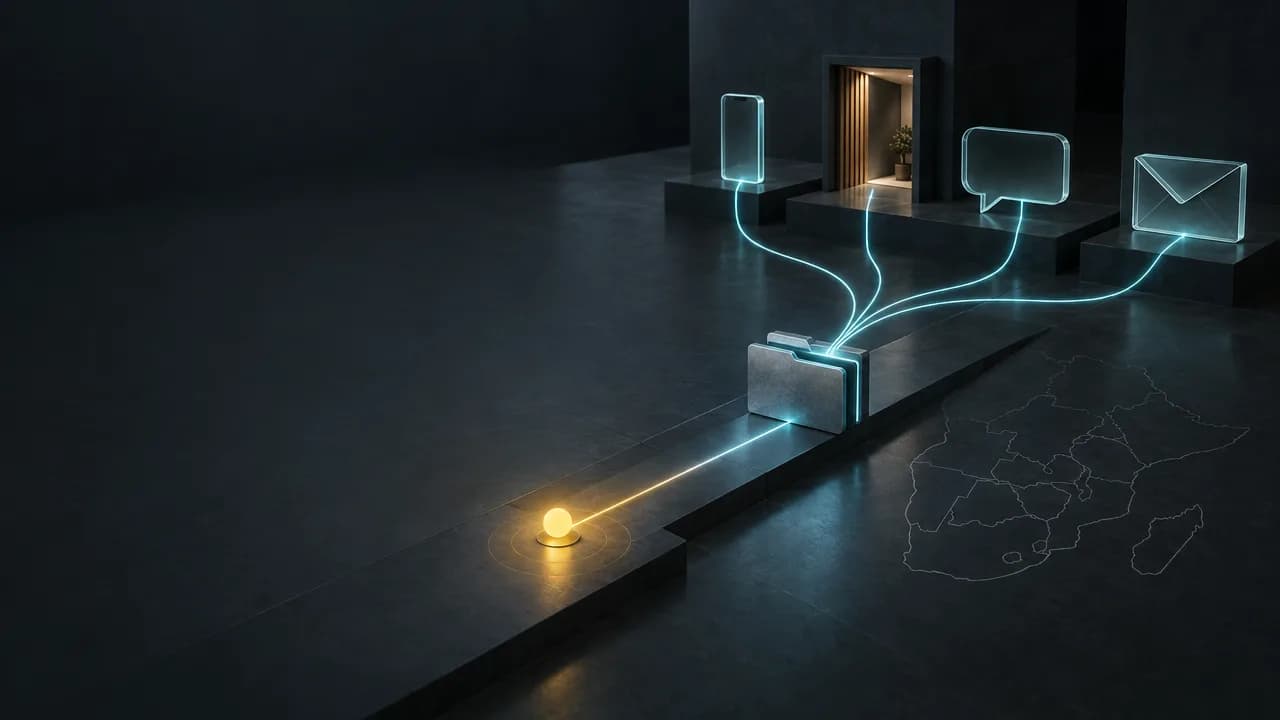
The journey continuity chain
Each link in the chain has a dependency, a step and a degraded mode. Two links must never be skipped, even when everything else is degraded: the case must be opened, if necessary on a manual log that is entered later, and the card must be blocked, if necessary by the fraud desk by hand. Everything else can wait, reroute or be done by a person. That distinction, between steps that may degrade and steps that must happen, is the most useful decision a continuity design records.
Nine dependencies, mapped to the case
| Dependency | How it fails | Degraded mode | Owner |
|---|---|---|---|
| Cloud and model providers | Region outage, throttling, model errors | AI steps fall back to rules and human queues; see Part 7 of Series 03 | Platform team |
| Network | Branch or contact-centre link down, mobile data congestion | Backup links; branch staff use a mobile device on a separate network | Infrastructure |
| Identity | Customer verification or staff sign-in fails | Call-back verification against known details; staff break-glass accounts for fraud and card actions only | Identity and security |
| Channel | App, WhatsApp, USSD or contact centre unavailable | Banner and recorded message pointing to the working channel; same case on any channel | Channel owners |
| Workflow | Orchestrator or AI triage unavailable | Rules-based routing to a fraud queue | Service operations |
| Data | Case or customer data stale or unreachable | Read-only view; actions logged for reconciliation | Data owner |
| Integration | Card system, courier or SMS gateway API fails | Queue with idempotency keys; manual entry at the fraud desk | Integration team |
| Staff | Fraud team at capacity or absent after hours | Duty roster, overflow team trained for blocking only | Fraud operations manager |
| Partners | Courier cannot collect, SMS provider throttles | Branch collection; second messaging route | Vendor manager |
Most of these owners have never met in one room about one journey. The map is the reason to put them there. Part 7 of this series, The service orchestration layer, explains how idempotency and compensation keep queued actions safe once the integration comes back; who owns the retry covers the engineering detail.
Degraded modes are designed around the case
Continuity designs often describe what each system does when it fails. A connected service describes what happens to the case. For Blouberg's fraud journey:
| Journey step | Normal | Degraded | Never |
|---|---|---|---|
| Report | App, WhatsApp or call; AI assistant collects details | Any working channel; staff collect details on a short form | Lose a report because a channel failed |
| Verify | One-time PIN or app approval | Call-back to a number on record, with security questions | Skip verification for a card action |
| Open case | Case created automatically with transaction details | Manual log with a reference number, entered into the case system within a set time | Act without a case reference |
| Block card | Automatic on confirmation | Fraud desk blocks by hand | Delay the block to wait for AI triage |
| Investigate | AI assistant drafts a summary for the fraud analyst | Analyst works from raw transactions | Let a model decide the dispute outcome |
| Replace card | Courier booked through partner integration | Branch collection offered | Promise a delivery date the partner has not confirmed |
| Close | Customer notified with outcome and redress route | Outcome by call or letter | Close the case without telling the customer |
The "Never" column is the policy. It is short, it should be signed by the accountable service owner, and it is the first thing a journey test checks. AI in the service journey explains why the dispute decision stays with a person in normal operation too.
Communicate around the case, on a channel that still works
The customer in the opening did not need the bank to fix its SMS gateway that evening. She needed to know her report had been received, what would happen next and when. Communication during a degraded journey follows four rules.
- Speak about the case, not the system. "Your fraud report, reference 4471, is open and your card is blocked" is useful. "We are experiencing technical difficulties" is not.
- Use a channel independent of the failure. If the SMS gateway is down, confirm in the app, by email or by call-back. The notification service needs its own second route.
- Tell staff and partners first. Contact-centre agents, branch staff and the courier should know the degraded mode before the first customer asks. A one-page script per degraded mode is enough.
- Close the loop when service returns. Every case opened in degraded mode gets a follow-up confirming its status once the full journey is back.
Test the journey during failure
A journey test runs a real journey, with test identities and test cards, while one dependency is deliberately failed or simulated as failed. Run it as a tabletop first, using the format in Part 9 of From AI Prototype to Production, then as a technical test in a non-production environment.
| Failure | Inject | Expected journey behaviour | Pass criteria |
|---|---|---|---|
| Model | AI assistant and triage unavailable | App form and staff take the report; rules route it to the fraud queue | Card blocked within the normal target; case opened; customer told |
| Identity | Customer one-time PIN and staff sign-in both fail | Call-back verification; break-glass accounts for fraud desk only | No card action without verification; every break-glass use logged and reviewed |
| Network | Contact-centre primary link lost for one site | Calls rerouted to another site; branch staff on backup devices | Queue time within the agreed degraded target; no reports lost |
| Downstream | Card system API times out after accepting a block | Integration queues with an idempotency key; fraud desk confirms by hand | Exactly one block per card; case shows the true state |
Measure each test end to end: time from first customer attempt to card blocked, number of channels the customer had to try, and whether the case record matched what really happened. If the journey passed but the case record is wrong, it did not pass. Measure resolution, not interaction in Part 9 defines the measures in full.
The South African version
- Regulation expects the whole operation. The Prudential Authority's Directive D4/2023, checked on 18 November 2026, directs South African banks to assess their practices against the Basel Committee's principles for operational resilience, which include business continuity planning and testing, mapping of interconnections and interdependencies of critical operations, and third-party dependency management. It replaced Directive 10 of 2021 and set a compliance date of 31 December 2024. A journey continuity chain is one practical form of that mapping. This is general information, not legal advice; your compliance function decides what your obligations require.
- Channels are mixed. Many customers move between app, WhatsApp, USSD, call centre and branch, often in one journey. A degraded mode that only works in the app leaves out the customers most likely to need help.
- Language and access. Degraded-mode messages and staff scripts should exist in the languages the bank serves, and the fallback channel must work for customers with disabilities. Accessibility is a continuity requirement, not an extra.
- Partners carry part of the chain. Couriers, messaging providers and, for public services, the trusted partners in Part 4 each own a link. Their continuity terms should name the degraded mode as well as an uptime percentage.
Contribution to the Connected Service Case Card
This part fills two fields of the Case Card introduced in Part 2. Blouberg's fraud journey, as an illustration:
continuity_mode:
  must_never_skip: [open case (manual log allowed), block card]
  degraded_modes:
    model_unavailable: rules routing to fraud queue; staff collect details
    identity_unavailable: call-back verification; break-glass for fraud desk only
    network_site_loss: reroute calls to second site; branch backup devices
    card_system_timeout: queue with idempotency key; fraud desk confirms by hand
  journey_test: quarterly, one failure per test, synthetic journey every 5 minutes
  owner: head of fraud operations
status_and_notifications:
  states: [received, verified, card blocked, investigating, replacement sent, resolved]
  primary_channel: app notification
  independent_fallback: email or call-back
  degraded_message: names the case reference, what is done, what happens next
  staff_and_partner_briefing: one-page script per degraded mode, before customers ask
  recovery_follow_up: every case opened in degraded mode confirmed after recovery
Journey continuity checklist
- The journey has a continuity chain with one owner per link.
- The "Never" steps are written down and signed by the accountable service owner.
- A synthetic test journey runs through each channel and alerts on failure regardless of component status.
- Staff and customer identity do not share a single point of failure, or the shared risk is known and accepted.
- Every degraded mode keeps the case open and its status accurate.
- Notifications have a route independent of the primary channel.
- Staff and partner scripts exist for each degraded mode.
- Model, identity, network and downstream journey tests have been run, with results recorded.
- Cases opened in degraded mode are followed up after recovery.
Next: Part 9, Measure resolution, not interaction. Previous: Part 7, The service orchestration layer. All parts are on the series page.
How CloudNala can help
CloudNala maps continuity for one service journey at a time. We build the journey continuity chain with the service owner and every dependency owner, write the "Never" steps and degraded modes around the case, design customer and staff communications for each degraded mode, and run journey tests for model, identity, network and downstream failure. You leave with a chain your teams have tested, a synthetic journey monitor and the two Case Card fields completed for the journey.
Work with CloudNala
CloudNala helps organisations move from technology ambition to practical execution across cloud, AI, data, platform engineering and digital services.
Whether you are exploring AI, modernising your cloud environment, building a public-sector digital service, or turning an idea into a working MVP, we can help you shape the roadmap and deliver the next step.
Book a Journey Continuity Review or write to us at consult@cloudnala.co.za